
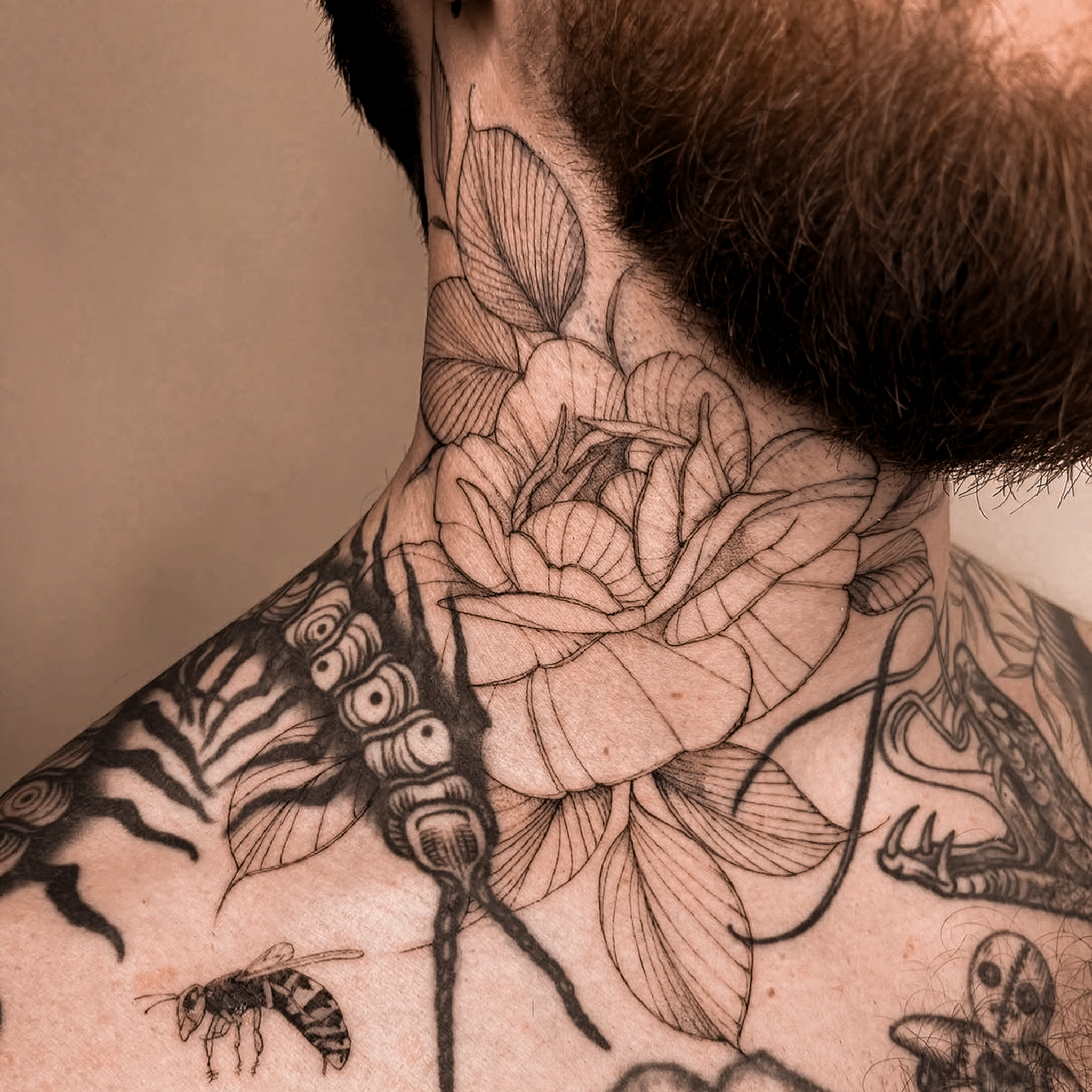
A face tattoo, hand tattoo, or neck tattoo is a powerful way to express yourself. At the same time, these are also some of the most visible and often most talked about (and sometimes taboo) tattoos.
Whether you’re considering a small symbol on your finger, a design on your neck, or a tattoo on your face: these placements require extra thought. At BlackBear Ink, we’re intentionally more critical when it comes to tattooing the face, hands and neck.
Thinking about getting a tattoo in one of these spots? In this article, we’ll explain what you should know about visible tattoos, pain levels, fading, healing, aftercare, and how BlackBear Ink approaches these placements.
Tattoos on the face, hands, and neck are immediately noticeable. Because of that, they often carry deep personal meaning or serve as a strong style statement.
Even though tattoos have become much more mainstream over the years, face tattoos, hand tattoos, and neck tattoos are still sometimes seen as rebellious or unconventional. In certain industries or cultures, they may still carry a stigma.
With that said, many people are drawn to these placements because they project confidence, individuality and personality.
Just keep one thing in mind: a tattoo on your face, hands, or neck will always attract attention. Sometimes positive and sometimes the kind of look that silently says, “You might regret that later.”
Before booking an appointment for a tattoo in such a visible area, there are a few important factors to consider.
The skin on the face, hand and neck is thinner and contains more nerve endings than many other parts of the body. Because of this, a face tattoo, hand tattoo, or neck tattoo can be more painful than tattoos in other areas.
Of course, pain tolerance varies from person to person. Some people handle it just fine, while others find it quite intense.
A common question is: Do hand tattoos fade faster?
The short answer: yes.
Because of friction, constant movement and frequent use, tattoos on the hands and fingers tend to fade more quickly than tattoos on other parts of the body. Finger tattoos, in particular, are known for fading within just a few months.
For this reason, many tattoo studios do not offer free touch-ups on fingers or hands.
A face tattoo, hand tattoo, or neck tattoo is difficult to hide. It’s worth considering how a tattoo in these areas might affect your career or professional opportunities.
Some industries still have strict policies regarding visible tattoos. You may also encounter clients or colleagues who have certain expectations. Or, let’s be honest, prejudices.
Because these tattoos are so visible, they can be harder to remove or cover if you change your mind later.
Laser removal is possible, but it’s often expensive, time-consuming, and not always completely effective. That’s why it’s important to be confident in your design and placement before committing to a tattoo in these areas.
Healing a tattoo in these visible areas can come with a few extra challenges.
Your face moves whenever you talk, laugh or eat. Your hands are used (and washed 👀) all day long and often rub against clothing or surfaces.
This constant movement can affect the healing process, cause mild irritation, and sometimes contribute to faster fading.
Tattoos on the face, hands, and neck are constantly exposed to the outside world.
Your hands touch surfaces throughout the day, your face is exposed to sunlight, and your neck may rub against clothing or collars. Because of this, these placements require extra attention when it comes to tattoo aftercare.
Hand tattoos tend to have it the hardest.
Washing your hands, typing, exercising, or simply holding objects can cause a tattoo to fade faster or become irritated during the healing process.
In short: your hands rarely get a break.
A proper consultation with your tattoo artist is essential. Talk about the design, size, placement and expectations.
Tattoos on the face, hands, and neck require a high level of precision, so it’s best to choose an artist with experience in these placements.
Proper aftercare is crucial for tattoos in these areas.
Important aftercare tips include:
Keep the tattoo clean
Touch the tattoo as little as possible
Avoid excessive sun exposure
Use sunscreen once the tattoo is fully healed
Moisturize the skin with a suitable tattoo cream
Good tattoo aftercare helps prevent infection, irritation, and premature fading.
At BlackBear Ink, we believe everyone should have the freedom to decorate their body however they choose. We aim to be a safe and welcoming space where everyone feels comfortable expressing themselves.
At the same time, each artist reserves the right to be thoughtful and selective about who we tattoo and where we tattoo.
Within the tattoo industry, there are a number of unwritten rules. Some artists only tattoo the face, hands, or neck on people who already have many tattoos. Others might only place small ornamental designs on fingers and refuse to tattoo the palm of the hand.
There are also artists who simply don’t feel comfortable tattooing these areas at all. Aside from the factors mentioned above, tattooing these placements can be technically challenging. The skin has many grooves, folds, and ridges that can cause ink to spread or prevent it from settling evenly.
This is not meant to discourage or judge anyone’s choices. Our artists simply want everyone who walks out of our studio to have a tattoo that looks great for as long as possible. And sometimes that means suggesting a different placement or design.
That said, don’t hesitate to reach out and ask for what you want. Every artist has their own style and approach, and we’re always happy to think things through with you.
A face tattoo, hand tattoo, or neck tattoo can be a powerful form of self-expression. At the same time, these placements require extra attention; both during the tattooing process and throughout healing.
With the right preparation, an experienced artist, and proper aftercare, tattoos in these areas can heal beautifully and stay looking great for years.
Take your time choosing your design, listen to your artist’s advice, and be patient during the healing process.
Because at the end of the day, a good tattoo is for life. And that is worth thinking through.
share