
AI is everywhere these days. Before long, even your fridge will probably have an opinion about your tattoo idea. And to be fair, tools like ChatGPT can be great for finding inspiration.
But when it comes to designing an actual tattoo, we recommend not treating AI as the final destination.
A tattoo isn’t a profile picture you can delete after three days. Your design shouldn’t just look good on a screen, it also has to work as a tattoo.
And that’s exactly where AI surprisingly often misses the mark.
These days, we regularly see people email us or walk into the studio with an AI-generated image and say, “I want exactly this.”
The problem is that AI isn’t a tattoo artist. It doesn’t understand how ink behaves in skin, how lines heal, or what fine details will look like five years from now.
The result is designs packed with details that are far too small, lines that will eventually blur together, shading that’s technically impossible to tattoo, anatomy that would give an orthopedic surgeon a headache, and artwork that only looks good when you’re zoomed in to 400%.
A great tattoo says something about you. It can represent a memory, an emotion, a chapter of your life, or simply something that makes you happy.
AI mainly works by combining existing images and styles it has learned from across the internet. That’s why so many AI-generated tattoo designs end up feeling like someone threw Pinterest into a blender.
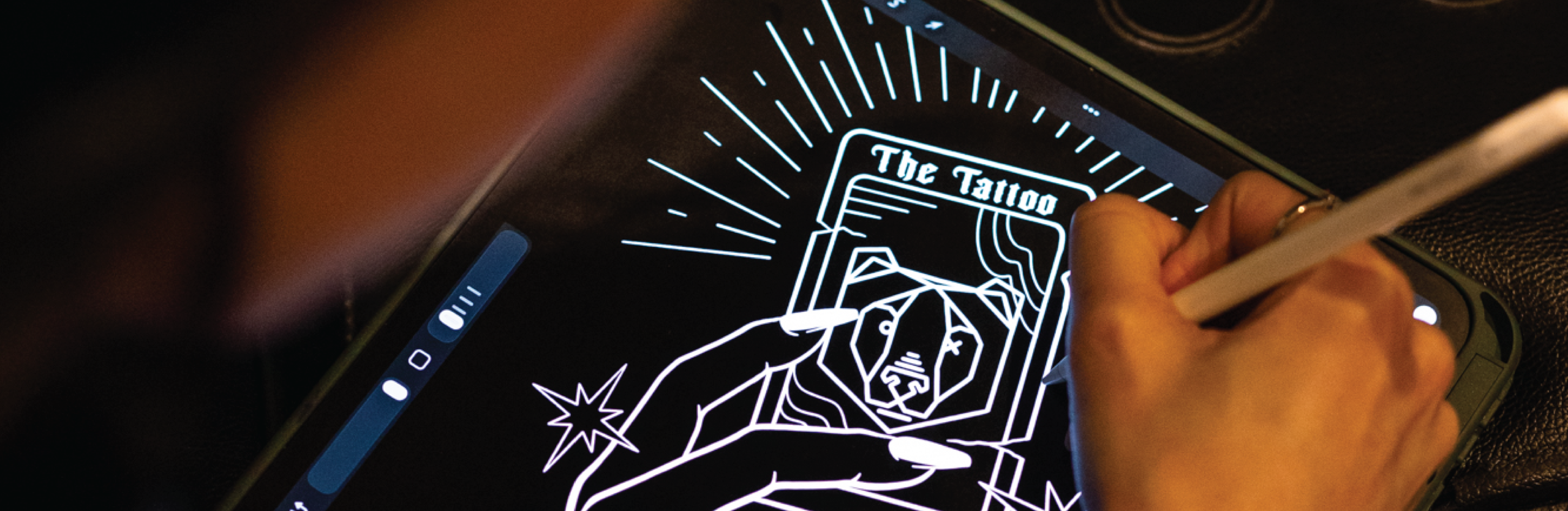
Many AI-generated tattoo designs are simply not technically possible to tattoo.
That’s because AI doesn’t take into account:
The result is often a design that looks great digitally but needs to be completely rebuilt in real life. A tattoo artist looks at a design in a very different way than AI does.
Luckily, there are plenty of ways to create a great tattoo design without a robot deciding that your flower needs six extra fingers.
With tools like Canva and Pinterest, you can easily create mood boards.
Collect things like:
This helps a tattoo artist much more than a single complete AI-generated image that doesn’t actually make sense from a tattooing perspective.
You don’t have to be Picasso. Seriously. Even a simple sketch on paper can be incredibly helpful when it comes to communicating your idea. So go ahead—bring on those stick figures and square little houses.
Do you know someone who’s good at illustrating? Great. A hand-drawn design often has much more character than an automatically generated image.
Plus, the chances of mysterious extra teeth or floating fingers are significantly lower.
This remains the best option.
During a consultation, a tattoo artist looks at:
A good artist doesn’t just create a beautiful design. They create a tattoo that will still look great years from now.
Of course you can. AI can be a great tool for:
But use AI as a tool—not as the final design.
A tattoo is a craft. Not an AI speedrun.
AI-generated tattoo designs can look impressive, but in practice they’re often not technically realistic or personal enough for a real tattoo.
Want a tattoo you’ll still love ten years from now? Work with a real tattoo artist. In the end, that almost always leads to a better, more beautiful, and more unique result.
And just as importantly: an artist knows the difference between a beautiful shadow and an ink blot that looks like a soggy croissant.