
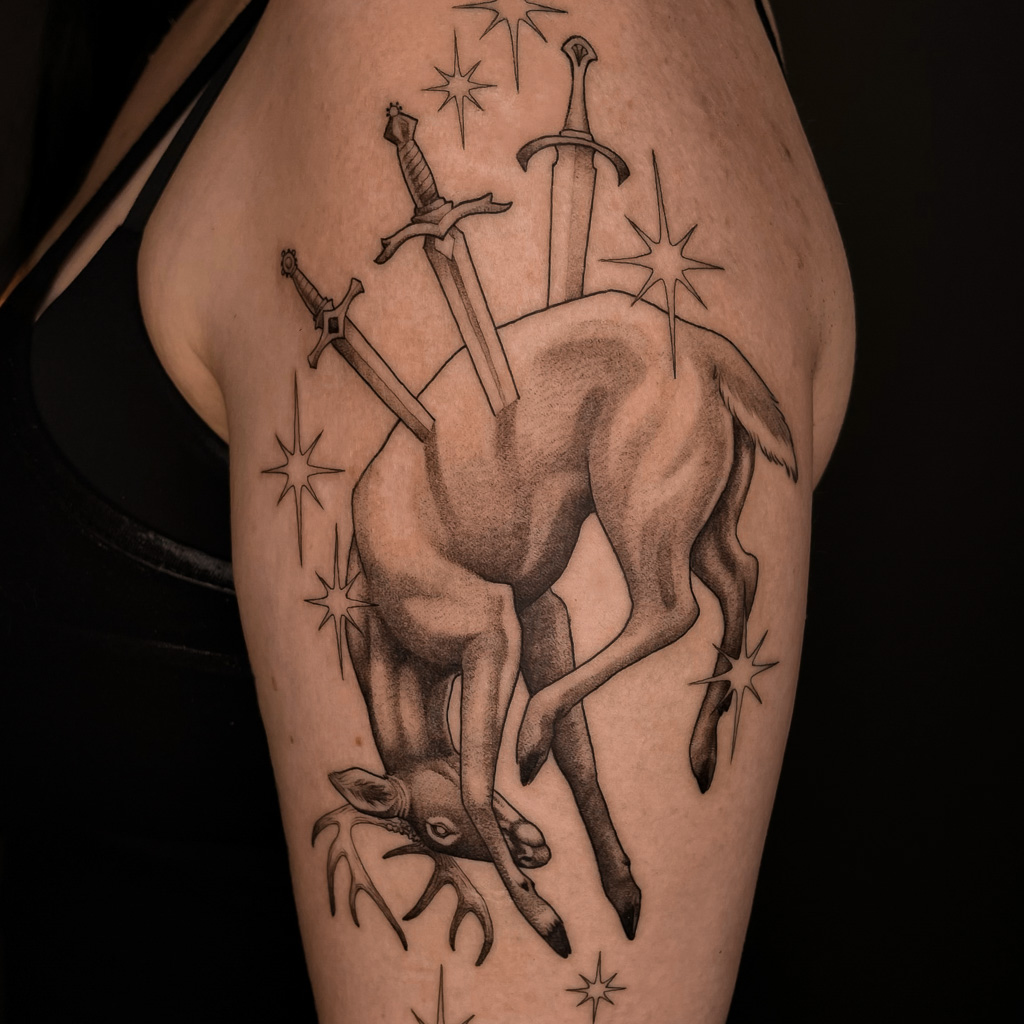
AI is everywhere these days. At this rate, your refrigerator will probably have an opinion about your tattoo idea before long.
And to be fair, tools like ChatGPT can be incredibly useful for finding inspiration.
But when it comes to designing an actual tattoo, we strongly recommend not using AI as the final stop in the process.
Why? Because a tattoo isn’t a profile picture you can delete three days later. It’s permanently on your skin. That means the design needs to do more than look good on a screen- it needs to work as a tattoo.
And that’s where AI surprisingly misses the mark quite often.
These days, we regularly see people emailing us or walking into the studio with an AI-generated image and saying: “I want this exact tattoo.”
At that point, our inner eye usually starts twitching a little.
AI isn’t a tattoo artist. It doesn’t understand how ink behaves in skin, how lines heal, or what details will look like five years from now.
As a result, AI-generated tattoo designs often include details that are far too small, lines that will eventually blur together, technically impossible shading, anatomy that would give an orthopedist an instant headache, and designs that only look good when you’re zoomed in 400%.
That hyper-realistic lion with blue eyes, a compass, a clock, a forest, a Viking helmet, and an entire galaxy crammed into one design? Sure, it looks impressive online until you realize it’s supposed to fit on a five-inch forearm.
A great tattoo says something about you. A memory, a feeling, a chapter of your life, or simply something that makes you happy.
AI mainly works by combining existing images and styles it finds online. Because of that, many AI tattoo designs feel like someone threw Pinterest into a blender and hit “purée.”
Beautiful? Sometimes.
Unique? Not really.
And let’s be honest: if twelve other people use the exact same prompt, you probably don’t want to end up with the tattoo version of a generic IKEA wall print.
The reality is that many AI tattoo designs simply aren’t technically tattooable.
That’s because AI doesn’t consider:
What you often end up with is a design that looks incredible digitally but has to be completely rebuilt before it can become a real tattoo.
A tattoo artist looks at a design very differently than AI does.
Where AI thinks: “More details = better.”
A tattoo artist thinks: “In three years, that’s going to look like one giant gray potato.”
Fortunately, there are plenty of ways to create a great tattoo design without letting a robot decide that your flower needs six extra fingers.
Tools like Canva and Pinterest are perfect for creating mood boards.
Collect things like:
This gives your tattoo artist far more useful information than a single AI image that doesn’t work in the real world.
You don’t need to be Picasso. Seriously.
Even a simple sketch on paper can be enough to communicate your idea. So bring on the stick figures and box-shaped houses. A rough drawing is often more helpful than you think.
Know someone who’s good at illustration? Great. A hand-drawn design often has far more character than an automatically generated image.
Plus, the chances of mysterious extra teeth or floating fingers are significantly lower.
This is still the best option.
During a tattoo consultation, an artist will consider:
A good tattoo artist doesn’t just create a beautiful design- they create a tattoo that will still look great years down the road.
Absolutely.
AI can be very helpful for:
Just use AI as a tool, not as the final design.
A tattoo is craftsmanship; not an AI speedrun.
AI tattoo designs often look impressive at first glance, but in practice they’re usually either technically unworkable or not personal enough for a meaningful tattoo.
If you want a tattoo you’ll still love ten years from now, work with a real tattoo artist. The result is always better, more beautiful, and far more unique.
And perhaps most importantly: a tattoo artist knows the difference between a beautiful shadow and an ink blob that looks like a wet croissant.
share